Hello!
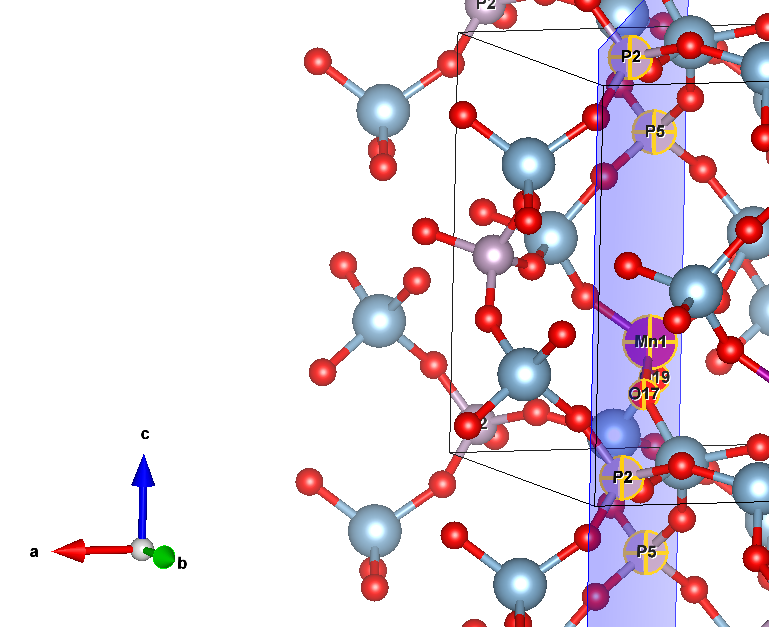
I am struggling to understand the way in which CRYSTAL rotates the atoms. Here is my structure:
reference.f34
I want to rotate all atoms so that Mn remains in place, and oxygens NN 21&23 move to the ac (xz) plane. This, in essence, is a rotation around the axis 10Mn-12P, the result of which should be that
Y coordinate of Mn = Y(O21) = Y(O23). The angle that should work is +-24.7159 degrees, depending on the direction that CRYSTAL uses.
So, I tried
ATOMROT
0 # include all atoms
999 1 # no translation & rotation around a specified axis
10 12 # atom labels that define rotation axis
+/-24.7159 # angle (degrees)
To the effect of
ALL THE  36 ATOMS IN THE REFERENCE CELL ARE MANIPULATED

SELECTED ATOMS ARE ROTATED AROUND THE AXIS DEFINED BY TWO ATOMS:  10  12
(DIRECTION COSINES  0.000  0.000 -1.000) BY AN ANGLE:  24.72

ATOM  10 AT.N.  25 COORDINATES   4.46889   0.00000   2.24246
ATOM  21 AT.N.   8 COORDINATES  -2.74300   2.67751   3.17915
ATOM  23 AT.N.   8 COORDINATES   3.56177   1.05955   3.17915
and
ALL THE  36 ATOMS IN THE REFERENCE CELL ARE MANIPULATED

SELECTED ATOMS ARE ROTATED AROUND THE AXIS DEFINED BY TWO ATOMS:  10  12
(DIRECTION COSINES  0.000  0.000 -1.000) BY AN ANGLE:  -24.72

ATOM  10 AT.N.  25 COORDINATES   4.46889   0.00000   2.24246
ATOM  21 AT.N.   8 COORDINATES  -2.25530  -3.73706   3.17915
ATOM  23 AT.N.   8 COORDINATES   3.07407   0.00001   3.17915
So the second method maybe worked? Except that I have been unable to visualize/confirm it using VESTA, because the output of edited geometry section looks the same as the input*.
So, my questions are:
- how to validate the result of rotation?
- when using ROTCRY+MATROT, where is the origin of rotation?
- which method of rotation I should use in this situation?
*VESTA, of course, does not open .f34 files, so my usual workflow is to convert CRYSTAL output to a VASP-POSCAR format:
Structure description line
1.0 #scaling factor
[DIRECT LATTICE VECTORS CARTESIAN COMPONENTS (ANGSTROM)]
List-of-elements
Amounts-of-each-element
Direct or Cartesian # coordinate format
[list of coordinates in the selected format]