
malloc during BOLTZTRA (Pproperties)
-

Here is an old input that caused malloc on two different computer systems (I think one of these was Cineca, but that one was run for me by my colleague). I do not need the result of this calculation anymore, but I was told to share it during Crystal school this autumn.
malloc.d3
sb_wyckoff_tzvp.f9 -
Hello!
I found the source file. I have also learned that the .f9 was calculated with Crystal17, and that malloc happened in Props17, not in Props23 (I am likewise not sure whether the calculation that failed for my colleague was done using v17 or v23). This might have been a limitation of the machine that I was using, because the same calculation didn't crash with NEWK 36 72.
malloc.d12I am sorry if that turns out irrelevant, and of no use in the current version of Crystal.
-

Hi,
We have run some tests and we have identified the origin of the problem. The calculation fails in the evaluation of the Fermi energy in the NEWK option (so before getting to the BOLTZTRA step) because of large memory requirements due to a very large number of k-points being asked and because of the replicated-memory parallel implementation of that bit of code.
In that part of the code, with Pproperties (parallel version), data are replicated in memory by each process.
We have run tests on this system in parallel with different number of processes (on a computing node with 128 CPU cores) and for different shrinking factor parameters of the NEWK keyword. Results are summarized in the table below:
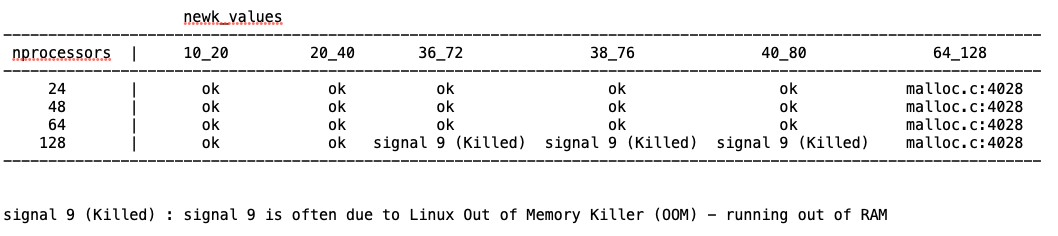
"ok" marks combinations for which the calculation run without errors. The trend is clear and can be rationalized as follows:
- reducing the number of k points reduces memory requirments
- reducing the number of MPI processes effectively increases the available memory/process
Hope this clarifies things and helps find a way forward,
Hello! It looks like you're interested in this conversation, but you don't have an account yet.
Getting fed up of having to scroll through the same posts each visit? When you register for an account, you'll always come back to exactly where you were before, and choose to be notified of new replies (either via email, or push notification). You'll also be able to save bookmarks and upvote posts to show your appreciation to other community members.
With your input, this post could be even better 💗
Register Login