
Stability calculations
-

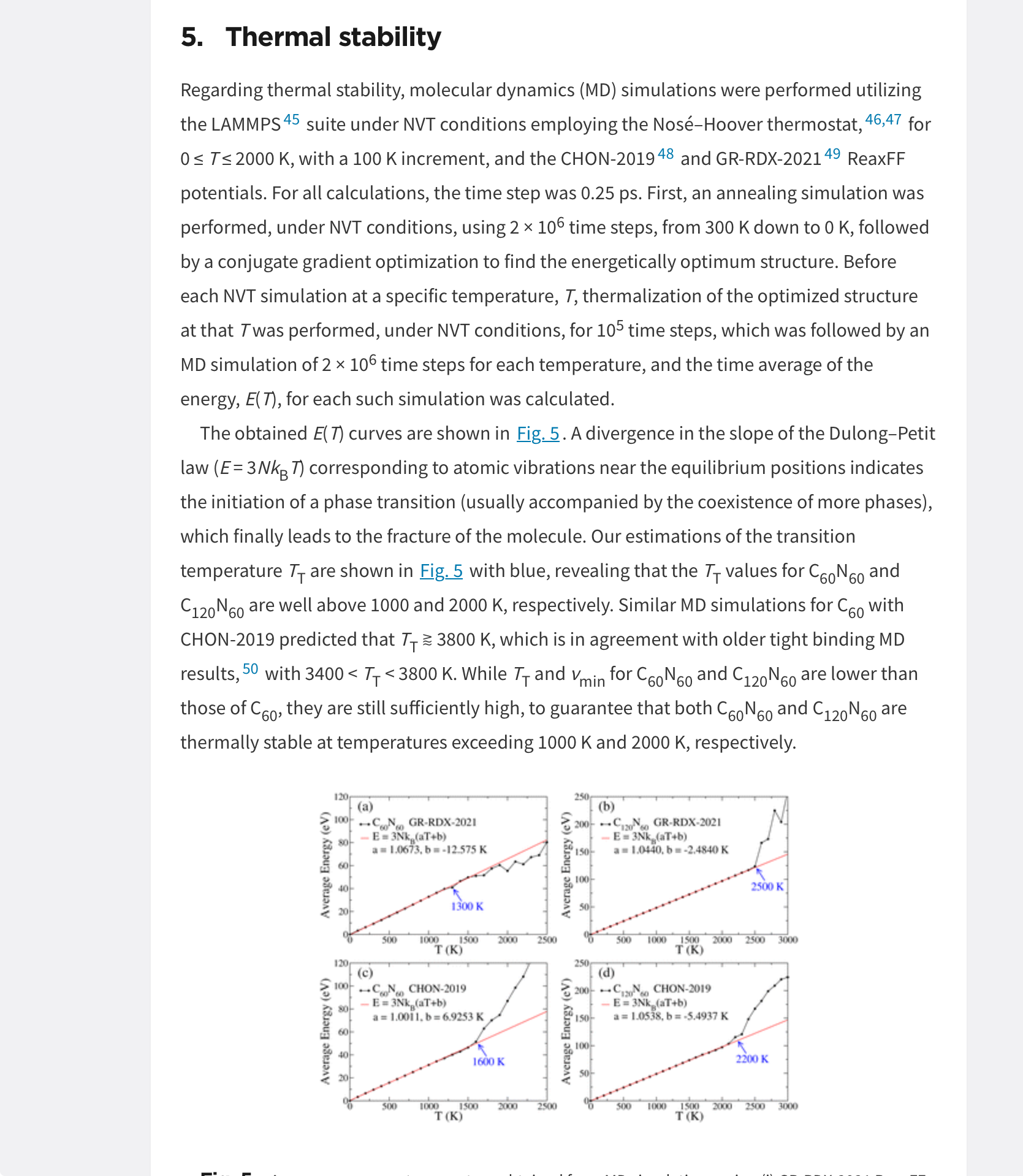
I have a paper revisions requested and they asked for stability calculations. I found a similar paper, they used MD calculations. Thier plot are shown below and they talk about atomic vibrations and Dulong-Petit law. I was wondering if that has anything to do with lattice dynamics of any sort I can calculate in CRYSTAL to measure this equilibrium point before phase transition occurs? So not necessarily the method in the paper below, but something similar that show molecular stability with a temperature in a similar fashion?
Thank you
-

Hi,
Stability is a broad concept that can be interpreted and analyzed in many ways. One way to look at it is the following: checking whether or not the Hessian of second energy derivatives is positive-definite (all eigenvalues are positive) or not, i.e. if the structure is a local minimum of the potential energy surface (PES). Indeed if small structural perturbations produce an energy decrease rather than increase (that is if some of the eigenvalues are negative) the structure can not be considered "stable".
Two types of Hessian matrix can be considered, which correspond to two types of stability:
-
Hessian with respect to atomic displacements within a fixed cell for dynamical (phonon) stability. This corresponds to checking if all harmonic frequencies are positive.
-
Hessian with respect to lattice distortions for mechanical stability (so-called Born stability conditions). This corresponds to checking if all the eigenvalues of the elastic tensor are positive.
Hope this helps,
-
-
Exellent. Can that be done at finite temperature? in the example I attached, they did MD simulations at increasing temps and at some point the deviation took place suggesting say at 1000 K system undergoes mechanical stability change, perhaps change in phase. Can Elastic tensors be used for that, e.g. can elastic tensors be calculated at various temperatures and see at which point they become negative to judge something about he instability temperature? Cause that woud work for me wel. Can elastic tensors be calculated at various temperatures or that concept does not exist?
-
Alessandro, I read your JPhysChem Lett paper from 2020. It discusses the thermo-elastic constant calculation. Can that be used as an argument, e.g., calculations at various temps would result in some decreasing elastic constant value until it approaches zero?
Additionally, any of these tensor calculations applicable to 0D systems? I have molecular cages, such as fullerene, for example -
Formally, if finite temperature effects are to be included, the internal static energy E needs to be substituted with the free energy F in the definition of the Hessian. This is easier said than done. However, for the elastic tensor, we do have an implementation to compute free energy derivatives with respect to lattice strain (i.e. thermo-elasticity). See also:
https://www.mdpi.com/2075-163X/9/1/16
The elastic tensor is not defined for 0D systems, where you could just explore the "dynamical stability" in terms of the vibration frequencies.
-
Sorry, Alessandro, been reading over the weekend the paper and the manual. How do I perform dynamic stability in terms of vibrational frequencies as a function of temperature? There seem to be various procedures involved on page 265 of the manual but it is not apparent to me how to proceed with the optimized molecular fullerene. Can you please provide input example for several temperatures?
Hello! It looks like you're interested in this conversation, but you don't have an account yet.
Getting fed up of having to scroll through the same posts each visit? When you register for an account, you'll always come back to exactly where you were before, and choose to be notified of new replies (either via email, or push notification). You'll also be able to save bookmarks and upvote posts to show your appreciation to other community members.
With your input, this post could be even better 💗
Register Login