Skip to content

Band Structure

Input Format

7 Topics 27 Posts
  • 0 Votes
    3 Posts
    54 Views

    Hi GiacomoAmbrogio ,

    I have attached the properties output file below so you can take a look. If there is anything else you want to check let me know.

    hBN.outp

    The main issue that I have is that, for instance, the set of eigenvalues at K= 91 ( 10 10 0) (which starts at line 2396 of the file) has labels that corresponds to the irrep of each band at that k point. You will find that in that same file, there is a list of character tables. However, the labels of the irreps that appear in the last character table is not the same as the labels that appear in the last set of eigenvalues. In general it seems that the n-th character table that appears does not contain the same irreps as the n-th set of eigenvalues. In other words, I do not know to what k-point each character table is referring to in order to properly identify the irreps.

  • How create band structure in P1 symmetry

    3
    0 Votes
    3 Posts
    88 Views

    Hi,

    Let me just add that of course in P1 there are no special high-symmetry points to guide you in the definition of the path, so you need to be a little creative. For instance, you can start from Gamma (0 0 0) and go to the edge of the FBZ along the b1 reciprocal lattice (1/2 0 0), to then go to (1/2 1/2 0), then to (0 1/2 0) then back to Gamma (0 0 0) and then to the edge along the b3 reciprocal lattice (0 0 1/2). Or something else! 🙂

  • 2D and Orbital Resolved bands

    2
    0 Votes
    2 Posts
    254 Views

    Hi,

    There may not be an option to "plot" orbital-resolved bands directly, but there is an option to compute and print principal atomic orbitals contributions to selected eigenvectors. See the ANBD keyword of the PROPERTIES module (page 307 of the CRYSTAL23 User's Manual).

    Yes, if your system is 2D, you can use the usual BAND keyword of the PROPERTIES module to define a 2D path to compute and plot the band structure (page 309 of the CRYSTAL23 User's Manual).

    If you need help on a specific system, just let me know

  • VBM and CBM position in HSE06 calculation

    5
    0 Votes
    5 Posts
    409 Views

    eascrizzi Thank you for your help.

  • Band Edge Alignment

    5
    0 Votes
    5 Posts
    402 Views

    Sure. I will try it. Thankyou so much.

  • Is there a software to create DOS/BAND input?

    5
    0 Votes
    5 Posts
    434 Views

    wonderful, thank you both

  • help with substitutional defects

    4
    0 Votes
    4 Posts
    325 Views

    Dear Jonas,

    first of all, 450 atoms is impressive indeed!
    Now moving on to a few comments/thoughts that might be of use to you.

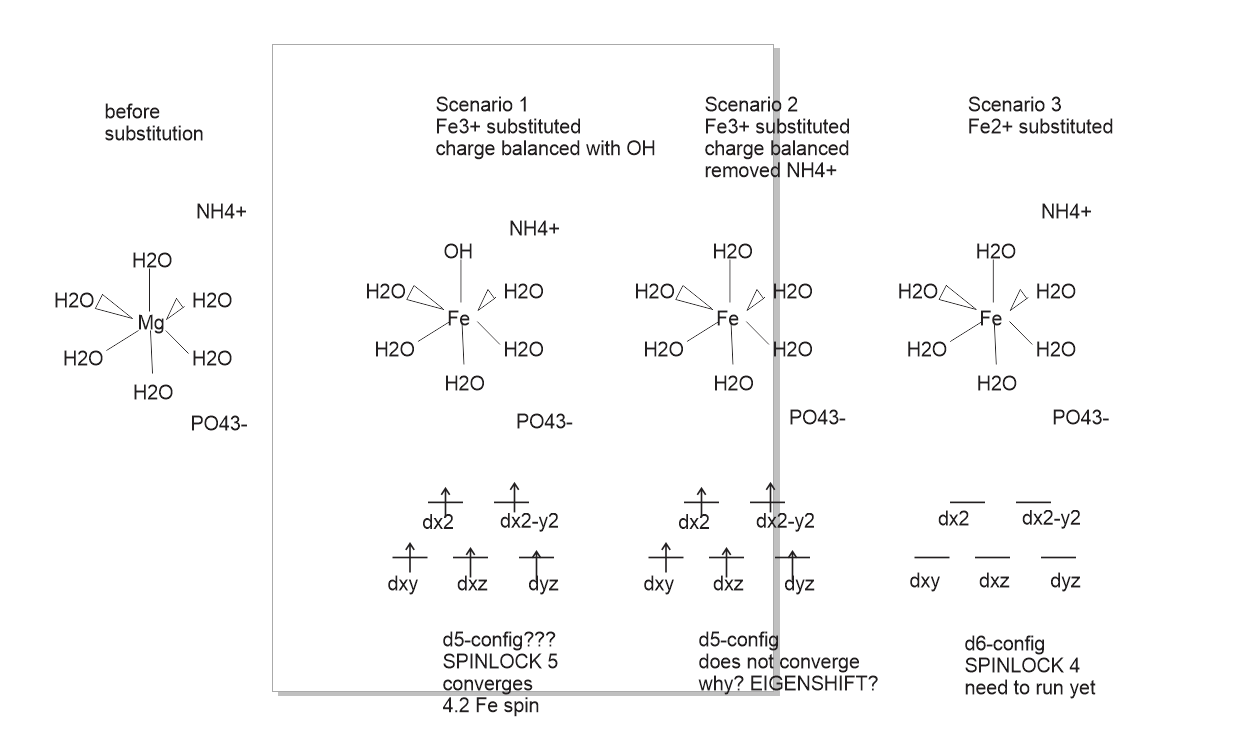
    i) From your input file, it appears you still have a few symmetry operators in your simulation cell. Worth checking whether/if that applies to the atoms in the Fe-centred octahedra as that might force a particular solution to the electronic configurations.

    ii) Given that your octahedra are not aligned with any particular crystallographic axis in your system, it is not always straightforward to extract the (d-)orbital occupations. You can have a look at the ROTREF keyword in the manual by which you can rotate the eigenvectors in the properties calculation to orient the frame along a principal axis.

    iii) In Scenario 1 you are right - you removed 1 H atom, from which indeed the symmetry of the octahedron has been reduced/broken. You could test the case without "neutralization", to see whether the extra electron would stay on the site or delocalize...formation energies might be a good guide...?

    iv) Scenario 2 is a bit more complicated. Given that you removed a whole NH4+ tetrahedron, I would expect significant structural distortions occurring in the surrounding of the defect. From there, a conducting state might be not so unrealistic - did you optimize the atomic positions and/or cell parameters following the inclusion of that defect? If so, could be worth seeing where the metallic states originate from (e.g., in the DOS or a charge density difference plot would be sufficient...don't forget SMEAR). The question is where is the extra electron from the anticipated Fe3+ ending if you remove the whole tetrahedron?

    v) Finally, I guess it really depends on what you see experimentally and what would be the most representative simulation cell matching the measurements to be able to extract meaningful data for the oxidation state. What could be potentially useful is to take simple bulk structures for which you know the oxidation state of Fe (e.g., Fe2O3, Fe3O4, ...), analyse the corresponding charge densities (e.g., Mulliken) and have a reference state for comparing the charge on the Fe-ion in your Struvite structure.

    Hope any of this is useful.

    Cheers,
    Aleks