

Skip to content
  • Home
  • Recent
Collapse
Brand Logo
CRYSTAL23
Latest v1.0.1
Tutorials Try the Demo Get a License
Tutorials Try the Demo Get a License Instagram
  1. Home
  2. Categories
  3. PROPERTIES
  4. Band Structure
  5. Is there a software to create DOS/BAND input?
How use CRYSTALpytools?
QMQDCHEM QMQDCHEM
(base) noctua-v2@noctua-v2-X9DR3-F:~/Desktop/RSF/band$ ls
 BAND.DAT  'BAND STRUCTURE.jpeg'   fort.25   fort.87   fort.9   INPUT   OUTPUT

Can I use BAND.DAT as *.BAND and OUTPUT as *.out files in code?

from CRYSTALpytools.electronics import ElectronBand
from pymatgen.electronic_structure.plotter import BSPlotter

band = ElectronBand.from_file('*.DAT', 'OUTPUT')
pmgband = mgoband.to_pmg(labels=[r'$\Gamma$', 'W', 'X', 'L', r'$\Gamma$'])
bsplot = BSPlotter(pmgband)
bsplot.get_plot(ylim=(-10, 10), zero_to_efermi=True)
Band Structure
4 Posts
0 Votes
How to obtain the irreducible representations of the electronic bands ?
DLP DLP

Hi,

I would like to obtain the irreducible representations of the eigenstates for a given crystal at each k-point. To do so, I am running properties with the following .d3 file:

NEWK
0 0
0 2
66 1
67 1
END

The output file (.outp) gives me the eigenvalues at each k-point with a label, for instance A'',A',E'',etc. In that same .outp file there is a list of character tables, which I assume that each character table corresponds to a k-point in order of appearance. However, the irreps that appear in the n-th character table do not correspond to the irreps that appear in the n-th set of eigenvalues, meaning that you can have an irrep labelled B3 in the eigenvalues but for the corresponding character table there is no B3 irrep. How can I identify what the irreps of the eigenstates actually are or how they transform under the symmetry operations of the little point group ?

Band Structure
6 Posts
0 Votes
How create band structure in P1 symmetry
QMQDCHEM QMQDCHEM

Hi,

I am performing doping in a material that initially has space group 225, but the application of the substitution block from the manual the symmetry to be reduced to space group P1.
How can I calculate the band structure in P1?

Thanks!

Band Structure
3 Posts
0 Votes
2D and Orbital Resolved bands
Ehsangowdini Ehsangowdini

Hi

I have two questions regarding Band Plot,

1- Is there a way to plot Orbital-Resolved bands from CRYSTAL output?
2- Is there a way to create .d3 file for 2D bands?

Thank you so much

Band Structure
2 Posts
0 Votes
VBM and CBM position in HSE06 calculation
masoud37 masoud37

Dear Admin,
I hope this message finds you well.
I did an HSE06 calculation to find the band gap in a 2D material.
I got the value of 1.4 eV for the band gap, but VBM and CBM positions are not correct in the output of CRYSTAL:
TOP OF VALENCE BANDS - BAND 15; K 1; EIG -8.7684392E-01 AU
BOTTOM OF VIRTUAL BANDS - BAND 16; K 48; EIG -2.2555491E-01 AU
Can you help me solving this problem in this case?
I have attached the input and output files.INPUT.d12 output.out

Thank you in advance,
Masoud

Band Structure
5 Posts
0 Votes
Band Edge Alignment
Chhatra Chhatra

Dear CRYSTAL developers and users,

I would like to perform a band edge alignment calculation by referencing the valence/conduction band edges to the vacuum level in the context of photocatalysis. For this purpose, I need the planar-averaged electrostatic potential along the slab normal direction.

I have already generated the electrostatic potential in Gaussian cube format using the POTCUBE keyword (file: POT_CUBE.DAT).

My questions are:

Does CRYSTAL provide any direct tool or utility to compute the planar average of the electrostatic potential from POT_CUBE.DAT (or other related output files)?

If not, is it recommended to post-process the cube file externally (e.g., with scripts, VESTA, or custom Python routines)?

Any guidance, example workflows, or scripts would be greatly appreciated.

Best regards,
Chhatra Subba

Band Structure
5 Posts
0 Votes
Is there a software to create DOS/BAND input?
job314 job314

I admit I am not very good conceptualizing these symetry unique points on Brillouin zone or expressing them in .d3 file as a path. I have two structures below that I fully optimized and calculated vibrational frequencies. Now my task is DOS/BAND. Is there a GUI that would help me read the optimized structures and prepare .d3 file? Or can I use my optimization file somehow to extract those unique points?

SPACE GROUP (CENTROSYMMETRIC) : P 21/N

LATTICE PARAMETERS (ANGSTROMS AND DEGREES) - CONVENTIONAL CELL
A B C ALPHA BETA GAMMA
7.40400 21.53400 5.65700 90.00000 91.05000 90.00000

and

SPACE GROUP (CENTROSYMMETRIC) : P -1

LATTICE PARAMETERS (ANGSTROMS AND DEGREES) - CONVENTIONAL CELL
A B C ALPHA BETA GAMMA
10.70800 10.11400 6.41000 91.30000 88.30000 91.00000

Band Structure
5 Posts
0 Votes
help with substitutional defects
job314 job314

Alessandro,

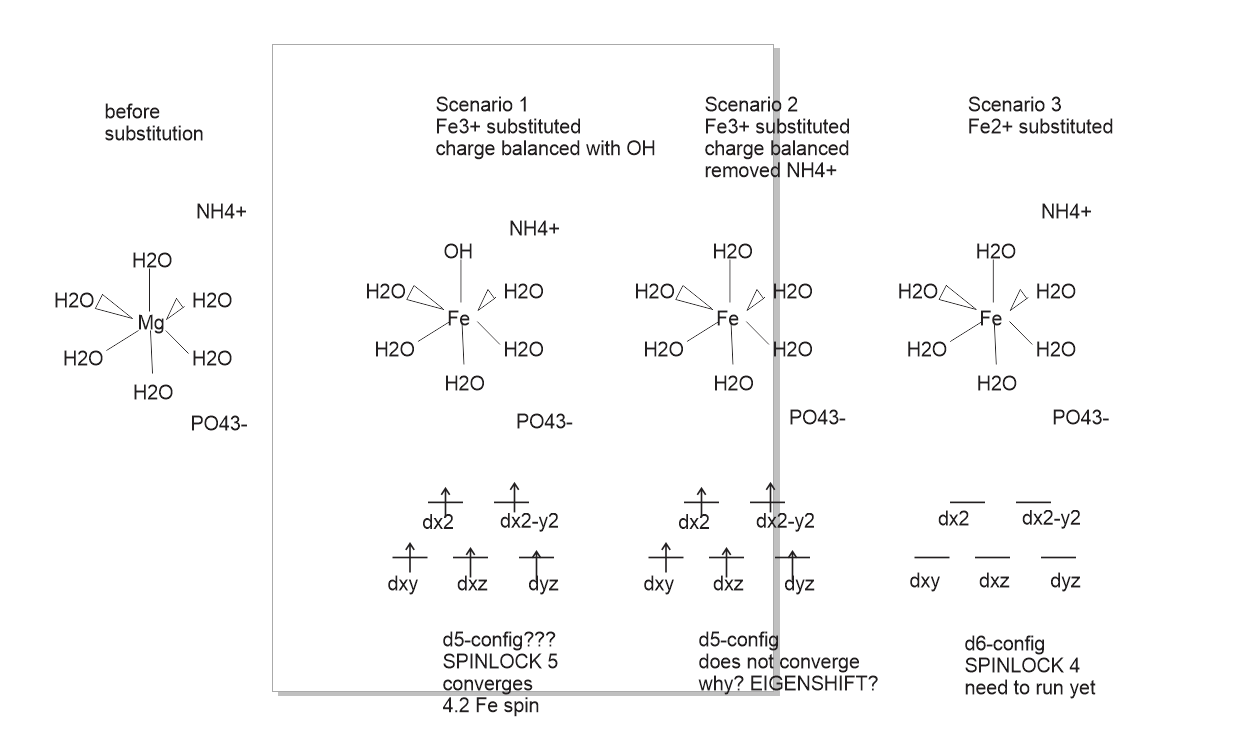
I am making a large 450 atom supercell of MgNH4PO4*6H2O to study Fe ion incorporation. We experimntally observe about 5% Mg atoms substituted with Fe - we do not know the oxidation state. So my supercell is big and I optimize this ionic solid with PBE-D3. My question is long and related on how to obtain required electronic state and converge in some instances. See below my diagram. I am exploring 3 different substitutional scenarios.

Scenario 1 is substituting Fe3+ and removing one proton to make it neutral. I am getting excellent SCF convergence, my guess is that this octahedral symmetry is broken somehow by removal of proton which helps SCF convergnce but crystal field with nearly 5 inpaired electrons is still preserved after the convergence with PBE-D3/pobDZVP.

Scenario 2 is an SCF problem. To charge balance it I remove NH4+. Immediately I get problems with SCF becoming conducting, I guess it does not want to be perfectly Oh symmetry and needs some distortion. I managed to converged it with PBE-D3/STO-3G in hopes that it will optimize to some solution which I can further optimize with PBE-D3/pobDZVP. But if I wanted to bias it with EIGENSHIFT and start with a large basus set, what would be my logic here? Robert Orlando used to very elegantly explain these things to me in the past.

Scenario 3 I haven't run yet. Seems like perfect Oh symmetry with the corresponding crystal field splitting and 4 unpaired electrons but my guess is it will run into the same problems as Scenario 2 and will need some biasing.

efbd21d6-0f3b-4ba8-81be-e7d34bbb1b15-image.png

Band Structure
4 Posts
0 Votes
Forum Maintenance

🛠️ We're down for maintenance on Tuesday, Sept 22. Back online soon! 🛠️


Is there a software to create DOS/BAND input?

Scheduled Pinned Locked Moved Band Structure
5 Posts 3 Posters 991 Views 3 Watching
  • Oldest to Newest
  • Newest to Oldest
  • Most Votes
Reply
  • Reply as topic
Log in to reply
This topic has been deleted. Only users with topic management privileges can see it.
  • job314
    job314
    job314
    wrote on last edited by
    #1

    I admit I am not very good conceptualizing these symetry unique points on Brillouin zone or expressing them in .d3 file as a path. I have two structures below that I fully optimized and calculated vibrational frequencies. Now my task is DOS/BAND. Is there a GUI that would help me read the optimized structures and prepare .d3 file? Or can I use my optimization file somehow to extract those unique points?

    SPACE GROUP (CENTROSYMMETRIC) : P 21/N

    LATTICE PARAMETERS (ANGSTROMS AND DEGREES) - CONVENTIONAL CELL
    A B C ALPHA BETA GAMMA
    7.40400 21.53400 5.65700 90.00000 91.05000 90.00000

    and

    SPACE GROUP (CENTROSYMMETRIC) : P -1

    LATTICE PARAMETERS (ANGSTROMS AND DEGREES) - CONVENTIONAL CELL
    A B C ALPHA BETA GAMMA
    10.70800 10.11400 6.41000 91.30000 88.30000 91.00000

    1 Reply Last reply
    0
    • aerba
      aerba
      aerba
      Developer
      wrote on last edited by
      #2

      Hi,

      I haven't used it in a while but I remember XCrySDen had a GUI for k path selection.

      What I typically do instead is use the Bilbao Crystallographic Server as a guide. If you navigate to "Space-group Symmetry" and then to "KVEC: The k-vector types and Brillouin zones of Space Groups", you will be able to select your space group of interest and then click on "Comparative listing of k-vector types".

      For instance, for your P-1 space group you get:
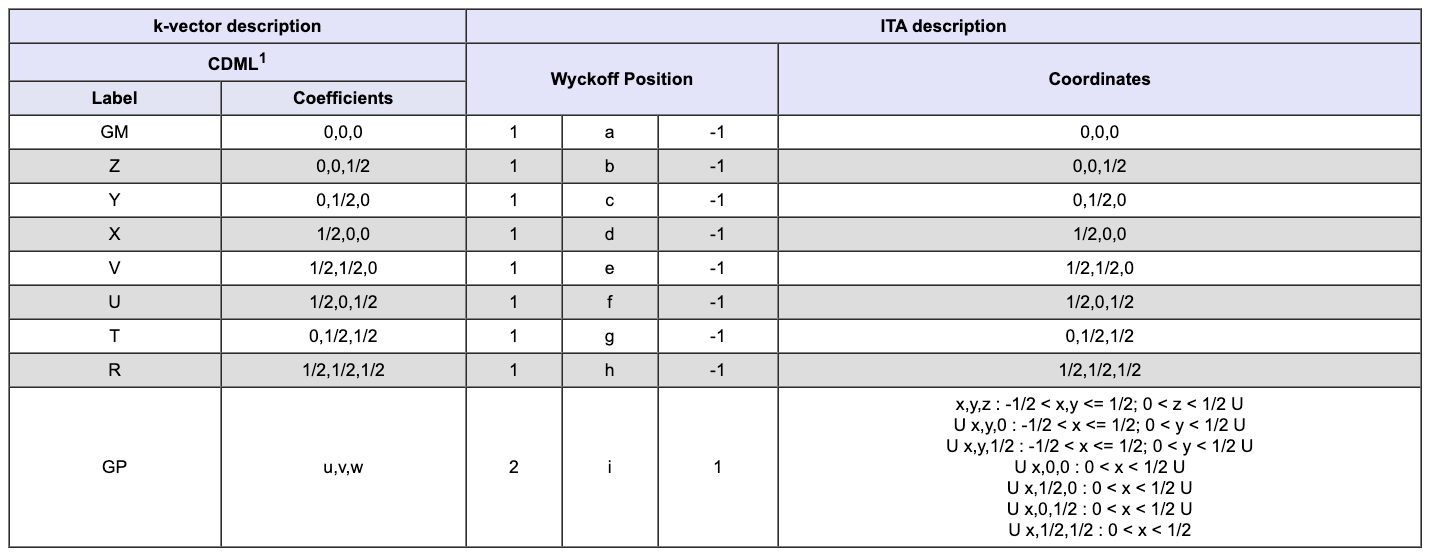
      Screenshot 2025-07-23 alle 08.42.42.png

      where you can find the coordinates of the high symmetry special points listed in the table (NOTE: if your space group admits a crystallographic cell that differs from the primitive cell, you will find both sets of coordinates in the table. Make sure you use the primitive ones to write the BAND input in the .d3 file) and also inspect the Brillouin zone:
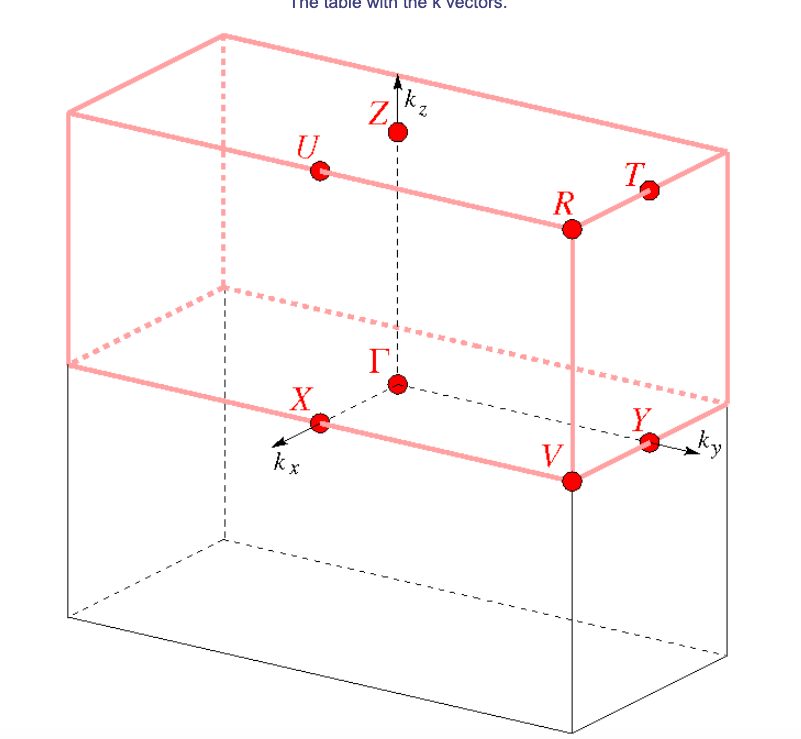
      Screenshot 2025-07-23 alle 08.43.02.png

      The order at which you explore these points does not really matter (unless you want to reproduce a specific path from some reference plot), as long as you explore most/all of them.

      Hope this helps,

      Alessandro Erba
      Professor of Physical Chemistry
      Department of Chemistry, University of Torino
      [email protected]

      1 Reply Last reply
      3
      • job314
        job314
        job314
        wrote on last edited by
        #3

        thank you, this is very useful for me

        1 Reply Last reply
        0
        • Aleks
          Aleks
          Aleks
          Expert
          wrote on last edited by Aleks
          #4

          Hi,

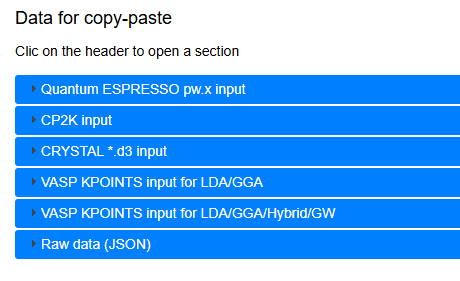
          Just as a potentially useful addition, someone also built an interface from SeeK-path (which is a k-path finder and visualizer) to CRYSTAL. You can upload your cif file structure and if you scroll down (once it has analysed it), you will find downloadable coordinates where the format is already in the .d3 style!

          https://seekpath.materialscloud.io
          4e0fc532-172c-461b-b2de-ff137c22b1ae-image.png

          Cheers,
          Aleks

          Aleksandar Živković, Scientific Assistant
          Department of Earth and Environmental Sciences, LMU Munich, Germany
          Crystal enthusiast

          1 Reply Last reply
          2
          • job314
            job314
            job314
            wrote on last edited by
            #5

            wonderful, thank you both

            1 Reply Last reply
            0

            Hello! It looks like you're interested in this conversation, but you don't have an account yet.

            Getting fed up of having to scroll through the same posts each visit? When you register for an account, you'll always come back to exactly where you were before, and choose to be notified of new replies (either via email, or push notification). You'll also be able to save bookmarks and upvote posts to show your appreciation to other community members.

            With your input, this post could be even better 💗

            Register Login
            Reply
            • Reply as topic
            Log in to reply
            • Oldest to Newest
            • Newest to Oldest
            • Most Votes


            Powered by Crystal Solutions
            • Login

            • Don't have an account? Register

            • Login or register to search.
            • First post
              Last post
            0
            • Home
            • Recent