Skip to content

World

Topics from outside of this forum. Views and opinions represented here may not reflect those of this forum and its members.

A world of content at your fingertips…

Think of this as your global discovery feed. It brings together interesting discussions from across the web and other communities, all in one place.

While you can browse what's trending now, the best way to use this feed is to make it your own. By creating an account, you can follow specific creators and topics to filter out the noise and see only what matters to you.

Ready to dive in? Create an account to start following others, get notified when people reply to you, and save your favorite finds.

Register Login
  • QMQDCHEM

    Hi!

    I am trying to compile Crystal 23 on Xeon E-2695v2 processors, but they are not supported by the Intel Toolkit. I am missing the instruction vfmadd231sd, giving GDB output:

    Program received signal SIGILL, Illegal instruction.
    0x0000000000e915a2 in timer_module_mp_init_timer_ ()
    (gdb) bt full
    #0 0x0000000000e915a2 in timer_module_mp_init_timer_ ()
    No symbol table info available.
    #1 0x0000000006828517 in initpp_ ()
    No symbol table info available.
    #2 0x00000000004073bd in MAIN__ ()
    No symbol table info available.
    (gdb) info registers
    Missing register name
    (gdb) x/i $rip
    => 0xe915a2 <timer_module_mp_init_timer_+82>:
    vfmadd231sd 0x73c02ed(%rip),%xmm0,%xmm3 # 0x8251898

    Could you please suggest a compilation method, such as using GCC or any other compiler? Is there a way to compile it using CMake?

    Thank you!


    Everything works with mpiifx, thank you very much!
  • ioikonom

    Hello,

    I am trying to run a single-point calculation in a 2D heterostructure that I had optimized in the past using a different code.

    I am taking the following error in the output file, which implies a problem with geometry.

    **NEIGHBORS OF THE NON-EQUIVALENT ATOMS
    
     N = NUMBER OF NEIGHBORS AT DISTANCE R
        ATOM  N     R/ANG      R/AU   NEIGHBORS (ATOM LABELS AND CELL INDICES)
     DISTANCE BETWEEN ATOMS   1 290 TOO SMALL: 0.3226 ANGSTROM
     PLEASE CHECK GEOMETRY
     ERROR **** NEIGHB **** USE KEYWORD SMALLDIST TO RUN ANYWAY**
    

    However, I haven't yet managed to find in the tutorials or in the manual the keyword SMALLDIST.
    Any suggestions?

    Thanks in advance,
    Ilias


    Hi Giacomo, Many thanks for your answer and suggestions. It works and will do a double check for the geometry. Have a good day, Ilias
  • CaesarSalad

    Hello,

    Is there a way to print the eigenvectors and eigenvalues of a system after a simulation has finished running?

    Chris


    Hi Chris, The reason you only see a few k-points printed is indeed that the printing options are not fully supported in parallel execution. In a parallel run, each MPI process handles a subset of the k-points, and only process 0 writes to the output file. As a result, you’ll only see the k-points assigned to process 0, which can be just a few, or even none, depending on how they are distributed. By default, the code distributes k-points in a round-robin fashion starting from the last process, so the gamma point is typically assigned to the last process and therefore never printed in a parallel execution. This behavior applies to both options 66 and 67. Try running the following input: NEWK 4 4 1 2 66 999 67 999 END However, you’ll need to run it on a single process for the eigenvectors to be printed correctly. If the calculation is too expensive to run on a single process, we may need to find an alternative approach to extract those values (though that won’t be straightforward).
  • esmuigors

    Dear developers and others.

    I am a bit confused about the output of the second hyperpolarizability calculation:

    *******************************************************************************
     SECOND HYPERPOLARIZABILITY (GAMMA) TENSOR
      COMPONENT      GAMMA
     *******************************************************************************
    
         XXXX    1.0077E+04 (   1.0077E+04)
         XXXY    4.1650E-13 (   1.9458E-08)
         XXXZ    5.9072E-13 (   2.5339E-08)
         XXYY    3.9702E+03 (   3.9702E+03)
         XXYZ   -1.0917E+03 (  -1.0917E+03)
         XXZZ    3.2158E+03 (   3.2158E+03)
         XYYY    7.0166E-13 (   1.4903E-07)
         XYYZ    5.2035E-14 (   2.4139E-08)
         XYZZ    1.9596E-13 (   1.3356E-08)
         XZZZ    6.7898E-13 (  -7.7814E-09)
         YYYY    7.2247E+03 (   7.2247E+03)
         YYYZ   -4.5162E+02 (  -4.5162E+02)
         YYZZ    3.0331E+03 (   3.0331E+03)
         YZZZ   -1.5476E+01 (  -1.5476E+01)
         ZZZZ    1.1089E+04 (   1.1089E+04)


    What are the quantities in parentheses? Are these a result of some rotation? If so, then why only the minor components change? Which ones are the real ones I should use?

    Thank You in advance.


    Dear prof. Erba, Have You got any time to look into the source maybe? Quite interestingly, I have recently noticed that in some other QC code values for the components change a lot (by up to 60%) from run to run, except for the dipole orientation (when the molecular dipole is aligned with z axis). Is (or could be) the reorientation You are referring to connected with this? Seems like something similar to the struggle fir gauge invariance in NMR calculations...
  • Crystal23Fan

    Hello,

    I would like to run CRYSTAL23 on a machine where the host CPU is an Intel Xeon Phi KNL 7250 (Knights Landing) — the KNL is used as the main host processor, not as a coprocessor. I’d like advice on how to build and run CRYSTAL23 to get the best possible performance on this platform.

    Specifically, could you please advise on what hybrid MPI+OpenMP layout tends to perform best on KNL for CRYSTAL23?
    Do you recommend running KNL in Cache mode (MCDRAM as L3 cache) or Flat mode (explicit allocation), for a CRYSTAL23?

    Thank you in advance for any guidance and best practices you can share.

    Best regards


    Hi, We provide a distribution of precompiled object files that can be linked on this architecture. You should be able to build and run CRYSTAL23 successfully using those. We do not have specific performance optimization data or configuration recommendations for the KNL platform. Performance is highly dependent on the system setup and workload characteristics, so we recommend running a few short benchmarks to identify the best configuration for your case. As regards OpenMP, the optimal number of threads depends on your memory limitations; however, we recommend not exceeding 8 threads per MPI process. Let me know if you have any further questions.
  • Igor12

    Hello!
    In many articles where CRYSTAL is used, I have come across the following phrase

    The energy optimization of the basis sets was undertaken using the Billy software.

    which is accompanied by a link to the manual. But there is no information about it in the manual or anywhere else. Can anyone explain what it is? Thank you in advance!


    Thank you!
  • GiacomoAmbrogio

    Dear CRYSTAL community,

    From Monday 15 to Thursday 18 December 2025, the 39th Winter School in Theoretical Chemistry will take place in Helsinki, Finland.
    This year’s focus is on Electronic Structure Theory! The School is organised by the Department of Chemistry, University of Helsinki, and is open to everyone in academia: students, postdocs, and professors. Best of all, it’s free of charge!

    📍 Location:
    Helsinki - Finland
    City Center Campus of the University of Helsinki

    🎓 Lecturers:
    Jacques Desmarais [Jacques] (University of Turin)
    Janus Juul Eriksen (Technical University of Denmark)
    Arno Förster (VU Amsterdam)
    Christof Holzer (Karlsruhe Institute of Technology)
    Ida-Marie Høyvik (Norwegian University of Science and Technology)
    Stanislav Komorovsky (Slovak Academy of Sciences)
    Frank Neese (Max Planck Institut für Kohlenforschung)

    📝 More info & Registration:
    For full details, registration form, and updates, please check the official Winter School page.

    Don’t miss this opportunity to meet leading experts, learn the latest in electronic structure theory, and connect with fellow scientists from around the world! 🌍


  • pcazade

    Hello,

    I'm running an elastic and piezolectric calculation that stops due to an error when reading the fort.62 file. Please find below the error message provided by Slurm (scheduler manager):

    forrtl: Invalid argument
    forrtl: severe (24): end-of-file during read, unit 62, file fort.62

    The error happens at the end of the first strain step or at the beginning of the second, though the output file was not updated.

    Is there a solution to this error? It happened twice in a row. Is it possible to restart a piezoelectric/elastic calculation?

    Kind regards,
    Pierre


    Hi Alessandro, Thank you for your reply. I will use an isotropic shrink. I find it strange, though, to have the warning message as the structure was optimised. Anyway, I will rerun that. Kind regards, Pierre
  • job314

    Hi all, trying to eliminate a negative frequency via SCANMODE. Job aborts with no particular message before scanning. I have FREQINFO file for the restart
    FREQINFO.DAT INPUT.d12 input.f34 input.out

    EXTERNAL
    FREQCALC
    RESTART
    SCANMODE
    1 -10 10 0.4
    1
    END
    END
    
    SSSSSSSSSSSSSSSSSSSSSSSSSSSSSSSSSSSSSSSSSSSSSSSSSSSSSSSSSSSSSSSSSSSSSSSSSSSSSSS
    SCAN ALONG NORMAL MODES
    STARTING POINT: -10 ENDING POINT: 10 STEP:   0.40000
    (THE STEP IS GIVEN AS TIMES OF THE CLASSICAL AMPLITUDE AT THE QUANTUM GROUND
    STATE ENERGY. THE MAX ATOMIC DISPLACEMENT IN THE STEP IS GIVEN IN BOHR
    WITHIN SQUARE BRACKETS)
    
     MODE(CM-1) DISPLAC   TOTAL ENE(DFT)(AU)  CLASSICAL HARM ENE(AU)  NCYC    DE
    [MAX DISP -NATOM-]
      1( -62.1)
    [   0.113 -    3-]
    

    Either way, seems you got your geometry for further optimization Cheers, A
  • Ehsangowdini

    Hi

    I have two questions regarding Band Plot,

    1- Is there a way to plot Orbital-Resolved bands from CRYSTAL output?
    2- Is there a way to create .d3 file for 2D bands?

    Thank you so much


    Hi, There may not be an option to "plot" orbital-resolved bands directly, but there is an option to compute and print principal atomic orbitals contributions to selected eigenvectors. See the ANBD keyword of the PROPERTIES module (page 307 of the CRYSTAL23 User's Manual). Yes, if your system is 2D, you can use the usual BAND keyword of the PROPERTIES module to define a 2D path to compute and plot the band structure (page 309 of the CRYSTAL23 User's Manual). If you need help on a specific system, just let me know
  • CaesarSalad

    Hi,

    I am curious if Crystal accepts something like the cc-pVDZ-DK Gaussian basis set for the calculation of SOC effects in transition metals? From what I gather, it is an all electron basis set (https://www.basissetexchange.org/basis/cc-pvdz-dk/format/crystal/?version=0&elements=28). Would this require the keyword INPSOC in the basis set block of the input file?

    Chris


    Thanks Giacomo, much appreciated, Chris
  • Rams

    Hi,

    I am trying to simulate a slab model of thin film on substrate. When I ran the job, there was a convergence problem in the SCF cycle. My initial suspect was the interface, since I don't have extract geometrical configuration it was only a pure guess.

    So I ran a calculation with only the substrate, but still it did not convergence in SCF cycle with MPPcrystal. I reran the same calculation of only substrate with Pcrystal it converged in 20 cycles. So why is there discrepancy between both versions. I am attaching the input and output for both calculation here.
    Substrate_MPP.out
    Substrate_MPP.d12
    Substrate_Pcrystal.out
    Substrate_Pcrystal.d12

    To check if there is any issue with the MPP compilation, I added the REPLDATA tag in MPP input, so that it runs as Pcrystal, this time it again converged in 20 cycles.

    I would like to use MPPcrystal for my final structure of thin film to speedup the calculation and avoid memory issues, so could you let me what is the issue I am encountering with both the versions.

    Thanks & Regards,
    Rams


    Hi Rams, The need for relatively high values of FMIXING is not unusual, so what you are observing is expected. That said, you are correct that if FMIXING is set extremely high (close to 100%), there is a risk that the SCF procedure may reach converge before reaching the "true" ground state. This is not unique to your system, it is a general trade-off with strong damping. To improve robustness while still guiding the calculation toward the correct solution, you can try: Increasing TOLDEE: this tightens the SCF energy convergence criterion and will allow the SCF to continue reaching the minimum even with high FMIXING. Keep in mind, however, that this will typically require many more SCF cycles. Combining mixing with other stabilization strategies, such as level shifting (LEVSHIFT) or electronic smearing (SMEAR) (if applicable to your system), which often reduce the need for such extreme damping.
  • CaesarSalad

    Hello all. I have a question about CRYSTAL23 and how it works when it comes to calculating eigenvalues for certain k-points. Let's look at the example of SiO2 cell with 12 ions:

    *** K POINTS COORDINATES (OBLIQUE COORDINATES IN UNITS OF IS = 6)
    1-R( 0 0 0) 2-C( 1 0 0) 3-C( 2 0 0) 4-R( 3 0 0)
    5-C( 1 1 0) 6-C( 2 1 0) 7-C( 2 2 0) 8-C( 0 0 1)
    9-C( 1 0 1) 10-C( 2 0 1) 11-C( 3 0 1) 12-C( 1 1 1)
    13-C( 2 1 1) 14-C( 2 2 1) 15-C( 0 0 2) 16-C( 1 0 2)
    17-C( 2 0 2) 18-C( 3 0 2) 19-C( 1 1 2) 20-C( 2 1 2)
    21-C( 2 2 2) 22-R( 0 0 3) 23-C( 1 0 3) 24-C( 2 0 3)
    25-R( 3 0 3) 26-C( 1 1 3) 27-C( 2 1 3) 28-C( 2 2 3)

    So here it shows 28 k-points for the 6x6x6 Monkhorst-Pack grid, and if I understand correctly, the reason why it's not showing all 216 points is because the program recognizes the crystal symmetry so it knows that the energy at (1 0 0) is the same as at (0 1 0), (0 0 1), (-1 0 0), etc?

    If that is the case, then to build a high-symmetry path along Gamma-X-K-Gamma, for example... we could just take the points 4-R( 3 0 0) and 7-C( 2 2 0) and divide them by IS, which in this case is 6 to get the points (0.5, 0, 0) and (1/3, 1/3, 0). Would that be correct? Because that would make the extraction of eigenvalues quite simple for this path.

    Thanks in advance,

    Chris


    Hi Giacomo, That's a very useful answer, thank you! Chris
  • esmuigors

    Dear CRYSTAL support and others,

    I am new to CRYSTAL, hence the error is probably on my side.

    I am trying to perform a geometry optimization of a molecular crystal and then use it to compute the dielectric susceptibilities. If I understand it correctly, I need to use the keyword EXTPRT within the OPTGEOM section to export the optimized geometry and get a fort.34 file, which I then have to use in my next calculation with EXTERNAL keyword for the geometry.

    However, the run fails with an error message:

    ERROR **** CONOPT_ **** KEYWORD EXTPRT      NOT ALLOWED
    forrtl: error (78): process killed (SIGTERM)
    

    If I remove the EXTPRT keyword, the optimization runs just fine (at least with some of the functionals)! But I cannot get the geometry out of the .OUT file. I tried using the cell parameters I got after "CRYSTALLOGRAPHIC CELL" and run an elastic constant calculation; however, it failed with "WARNING!! FORCE 9 AT CENTRAL POINT IS GREATER THAN 10^-4. OPTIMIZE THE STRUCTURE AND RE-RUN" (there were multiple such messages for multiple force vectors) and the error

     ERROR **** BFGS_ **** PXK TOO SMALL
    

    So I am now at loss trying to get the geometry out of my optimization. Can anyone help please?

    Please find inputs for the jobs attached.
    CS2_normalP_r2SCANh.pob_tzvp_rev2_opt_withEXTPRT.out CS2_normalP_r2SCANh.pob_tzvp_rev2_opt_withoutEXTPRT.out CS2_r2SCANh.pob_tzvp_rev2_elconst_manualCOORDS.out


    Dear @esmuigors @esmuigors said in Unexpectedly cannot get the geometry after optimization: KEYWORD EXTPRT NOT ALLOWED: Should I only take the atoms labelled by "T" if the lattice is tetragonal, and which ones are to be taken in case of an orthorombic one? Or does "T"'and "F" stand just for "TRUE"'and "FALSE"? You are correct T and F stand for 'TRUE' and 'FALSE'. @esmuigors said in Unexpectedly cannot get the geometry after optimization: KEYWORD EXTPRT NOT ALLOWED: I am actually talking about the standard runPcry23 script. Perhaps it should not be like that? Or should I modify this script? That script already contain the few line of codes I suggested you, if not feel free to modify it and add those lines. @esmuigors said in Unexpectedly cannot get the geometry after optimization: KEYWORD EXTPRT NOT ALLOWED: Actually, I have now tried using only the "T"-labeled atoms and got this error: ERROR **** geometry **** FORMAT ERROR IN INPUT DECK I checked the input on top of the CS2_B1WC.pob_tzvp_rev2_gamma_onlyT.out file it seems like you are defining six atoms in the asymmetric unit, but only two atomic positions are specified in the input. CRYSTAL 0 0 0 64 6.34350113 5.54788046 9.71085545 6. ! Definitions of the number of atoms in the asymmetric unit 6 0.000000000000e+00 0.000000000000e+00 -5.000000000000e-01 16 2.303037287581e-17 3.119080311720e-01 1.207617820468e-01 ATOMSYMM ... The number of atoms in the asymmetric unit and the position specified should always match. I hope this helps you, Best,
  • masoud37

    Dear Admin,
    I hope this message finds you well.
    I did an HSE06 calculation to find the band gap in a 2D material.
    I got the value of 1.4 eV for the band gap, but VBM and CBM positions are not correct in the output of CRYSTAL:
    TOP OF VALENCE BANDS - BAND 15; K 1; EIG -8.7684392E-01 AU
    BOTTOM OF VIRTUAL BANDS - BAND 16; K 48; EIG -2.2555491E-01 AU
    Can you help me solving this problem in this case?
    I have attached the input and output files.INPUT.d12 output.out

    Thank you in advance,
    Masoud


    @eascrizzi Thank you for your help.
  • Chhatra

    Dear CRYSTAL developers and users,

    I would like to perform a band edge alignment calculation by referencing the valence/conduction band edges to the vacuum level in the context of photocatalysis. For this purpose, I need the planar-averaged electrostatic potential along the slab normal direction.

    I have already generated the electrostatic potential in Gaussian cube format using the POTCUBE keyword (file: POT_CUBE.DAT).

    My questions are:

    Does CRYSTAL provide any direct tool or utility to compute the planar average of the electrostatic potential from POT_CUBE.DAT (or other related output files)?

    If not, is it recommended to post-process the cube file externally (e.g., with scripts, VESTA, or custom Python routines)?

    Any guidance, example workflows, or scripts would be greatly appreciated.

    Best regards,
    Chhatra Subba


    Sure. I will try it. Thankyou so much.
  • Mo

    Hi,

    I am trying to calculate defect formation energies following Bailey's method (10.1103/PhysRevB.81.205214). In the paper they deal with anion vacancies by removing the anion and retaining its basis sets. When I follow this method I end up with a negative value in the SCF on the anion. For example, for Ca2ZnN2 I replaced one of the nitrogens with a 0 basis set (shown below), and using ATOMONLY to optimise (neutral defect). The calculation converged but the value on the anion vacancy was -1.3085951 (shown below) and when checking the geometry I found that the vacancy has merged with a neighbouring Zn atom. I can get the calculation to converge without producing a negative value in the SCF using FRAGMENT to keep the vacancy and the cation it merges with in place, but if I restart the calculation without FRAGMENT it will not converge. For Ca2ZnN2 this happens across all charge states of the anion vacancy I have tried (-2,-1,0,1,2). I have so far looked at five nitride compounds and this behaviour happens in three of them.

    What does the negative value here mean?
    Is there a way around this besides using FRAGMENT?

    I would appreciate any help.
    Thanks!

    0 4
    0 0 6 0 1.0
     4150.0 0.001845
     620.1 0.01416
     141.7 0.06863
     40.34 0.2286
     13.03 0.4662
     4.47 0.3657
    0 1 2 0 1.0
     5.425 -0.4133 0.238
     1.149 1.224 0.859
    0 1 1 0.0 1.0
     0.2832 1.0 1.0
    0 3 1 0.0 1.0
     0.8 1.0 1.0
    
     TOTAL ATOMIC CHARGES:
       8.1376632   8.1212165   8.1248702   8.1206438   8.1229391   8.1124523
       8.1236540   8.1193919   8.1205622   8.1248273   8.1212382   8.1375264
       8.1125477  -1.3072013   8.1125440   8.1257835   8.1206284   8.1377578
       8.1194311   8.1236914   8.1124840   8.1226134   8.1377863   8.1205830
       8.1173933   8.1258681   8.1207059   8.1240065   8.1199368   8.1207339
       8.1194493   8.1236090   8.1239754   8.1207282   8.1258496   8.1174264
       8.1206901   8.1197740   8.1207285   8.1206837   8.1239699   8.1174550
       8.1236610   8.1194374   8.1206695   8.1199530   8.1174242   8.1240181
      29.6808307  29.6816377  29.6812243  29.6819752  29.6710460  29.6849333
      29.6759320  29.6852850  29.6820377  29.6812695  29.6815737  29.6808892
      29.6849531  31.6491331  29.6849573  29.6819626  29.6819686  29.6807771
      29.6852479  29.6759483  29.6849717  29.6711835  29.6807525  29.6819924
      19.0454220  19.0459330  19.0431780  19.0431020  19.0432569  19.0451214
      19.0452198  19.0462440  19.0451348  19.0432244  19.0430908  19.0432040
      19.0459080  19.0452863  19.0925535  19.0432123  19.0444657  19.0432576
      19.0459533  19.0430879  19.0462163  19.0453976  19.0430765  19.0459700
      19.0634872  19.0436933  19.0366981  19.0429866  19.0441015  19.0430915
      19.0628392  19.0436877  19.0430659  19.0443015  19.0429753  19.0368146
      19.0436806  19.0628125  19.0649399  19.0442844  19.0435415  19.0442819
      19.0437081  19.0456880  19.0436812  19.0634794  19.0457099  19.0436711
    

    Thanks for your response, @aerba. ATOMREMO works but when you calculate the defect formation energies you end with values (for anion vacancies) that are higher than with using GHOSTS or the ATOMSUBS, with the latter values agreeing more with published defect formation energies.
  • job314

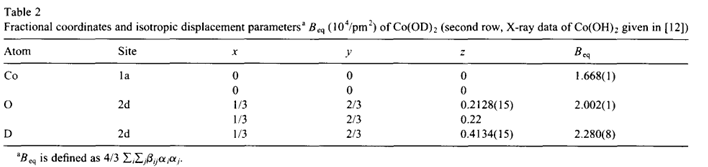
    Hi all, I am not getting the right geometry inputs for 1/3 and 2/3 positions. For example, for the structure below, I am trying to enter for the group 164:

    cd0c6958-e0dd-4057-9d25-f53bfc449b34-image.png

    CRYSTAL
    0 0 0
    164
    3.186 4.653
    3
    27	0.0 0.0 0.0
    1 0.333 0.6666 0.4134
    8	 0.3333 0.666 0.2128
    
    and it ends up being incorrect stoichiometry, which tells me these fractional positions were not parsed correctly.
    
     CRYSTAL CALCULATION
     (INPUT ACCORDING TO THE INTERNATIONAL TABLES FOR X-RAY CRYSTALLOGRAPHY)
     CRYSTAL FAMILY                       :  HEXAGONAL   
     CRYSTAL CLASS  (GROTH - 1921)        :  DITRIGONAL SCALENOHEDRAL             
    
     SPACE GROUP (CENTROSYMMETRIC)        :  P -3 M 1        
    
     LATTICE PARAMETERS  (ANGSTROMS AND DEGREES) - CONVENTIONAL CELL
            A           B           C        ALPHA        BETA       GAMMA
         3.18600     3.18600     4.65300    90.00000    90.00000   120.00000
    
    
     NUMBER OF IRREDUCIBLE ATOMS IN THE CONVENTIONAL CELL:    3
    
     INPUT COORDINATES
    
     ATOM AT. N.              COORDINATES
       1  27     0.000000000000E+00  0.000000000000E+00  0.000000000000E+00
       2   1     3.330000000000E-01  6.666000000000E-01  4.134000000000E-01
       3   8     3.333000000000E-01  6.660000000000E-01  2.128000000000E-01
    
     *******************************************************************************
    
     << INFORMATION >>: FROM NOW ON, ALL COORDINATES REFER TO THE PRIMITIVE CELL
    
     *******************************************************************************
    
     LATTICE PARAMETERS  (ANGSTROMS AND DEGREES) - PRIMITIVE CELL
           A          B          C        ALPHA      BETA     GAMMA        VOLUME
        3.18600    3.18600    4.65300    90.00000  90.00000 120.00000     40.903006
    
     COORDINATES OF THE EQUIVALENT ATOMS (FRACTIONAL UNITS)
    
     N. ATOM EQUIV AT. N.          X                  Y                  Z
    
       1   1   1   27 CO    0.00000000000E+00  0.00000000000E+00  0.00000000000E+00
    
       2   2   1    1 H     3.33000000000E-01 -3.33400000000E-01  4.13400000000E-01
       3   2   2    1 H     3.33400000000E-01 -3.33600000000E-01  4.13400000000E-01
       4   2   3    1 H     3.33600000000E-01 -3.33000000000E-01  4.13400000000E-01
       5   2   4    1 H    -3.33600000000E-01  3.33400000000E-01 -4.13400000000E-01
       6   2   5    1 H    -3.33000000000E-01  3.33600000000E-01 -4.13400000000E-01
       7   2   6    1 H    -3.33400000000E-01  3.33000000000E-01 -4.13400000000E-01
       8   2   7    1 H    -3.33000000000E-01  3.33400000000E-01 -4.13400000000E-01
       9   2   8    1 H    -3.33400000000E-01  3.33600000000E-01 -4.13400000000E-01
      10   2   9    1 H    -3.33600000000E-01  3.33000000000E-01 -4.13400000000E-01
      11   2  10    1 H     3.33600000000E-01 -3.33400000000E-01  4.13400000000E-01
      12   2  11    1 H     3.33000000000E-01 -3.33600000000E-01  4.13400000000E-01
      13   2  12    1 H     3.33400000000E-01 -3.33000000000E-01  4.13400000000E-01
    
      14   3   1    8 O     3.33300000000E-01 -3.34000000000E-01  2.12800000000E-01
      15   3   2    8 O     3.34000000000E-01 -3.32700000000E-01  2.12800000000E-01
      16   3   3    8 O     3.32700000000E-01 -3.33300000000E-01  2.12800000000E-01
      17   3   4    8 O    -3.32700000000E-01  3.34000000000E-01 -2.12800000000E-01
      18   3   5    8 O    -3.33300000000E-01  3.32700000000E-01 -2.12800000000E-01
      19   3   6    8 O    -3.34000000000E-01  3.33300000000E-01 -2.12800000000E-01
      20   3   7    8 O    -3.33300000000E-01  3.34000000000E-01 -2.12800000000E-01
      21   3   8    8 O    -3.34000000000E-01  3.32700000000E-01 -2.12800000000E-01
      22   3   9    8 O    -3.32700000000E-01  3.33300000000E-01 -2.12800000000E-01
      23   3  10    8 O     3.32700000000E-01 -3.34000000000E-01  2.12800000000E-01
      24   3  11    8 O     3.33300000000E-01 -3.32700000000E-01  2.12800000000E-01
      25   3  12    8 O     3.34000000000E-01 -3.33300000000E-01  2.12800000000E-01
    

    Hi Giu, it worked!
  • zhuyt

    Dear everyone,
    we are trying to calculate nanotube and we expected that the system owe the band gap about 2.0 eV, in the optimization process, words "POSSIBLY CONDUCTING STATE" appeared in the SCF file. Finally, the band gap converge to about 0.5 eV with incompact structure . we tried some methods as the follows: 1) reoptimization, sometime the structure changes a lot, the result seems to be correct, but it does not work for most cases. 2) try different keyword in optgeom section , such as, TOLDEG TOLDEX TOLDEE change to default value *0.1 , respectively; Hessian updating method change default to OLDCG; NoGUESS was added; ALLOWTRUSTR was added, while try different MAXTRADIUS TRUSTRADIUS for different number; the ICODE for FINALRUN was also 4; 3) try different parameter in SCF section: change the DFT functional (HSE06, B3LPY, PBE0); change convergence method( DIIS; LEVSHIFT; ANDERSON; BROYSDEN); the number of K point in K point sample was also changed with different value (8, 10 ,16); 4) the basis set also change, in most cases the pob_TZVP_rev2 were adopted.
    Unfortunately, the optimized structures seem to be unreasonable with different trying mentioned above.
    The system and basis parameter can be seen from the INPUT file as attachment. All the jobs were finished in Pcrystal, in the crystal user's Manual, it is noted that the keyword "FINALRUN" does not work in Pcrystal, we want to know whether it is true(crystal17, page 338). 7acd583a-f6b4-4d76-9906-063025cb61fa-QQ_1753424186406.png

    I would appreciate any help.
    Thanks!
    [INPUT](Invalid file type. Allowed types are: .png, .jpg, .bmp, .txt, .gif, .d12, .out, .dat, .d3, .outp, .input, .output, .dat, .f34, .cif, .pdf, .f9, .f20, .f13, .freqinfo, .out2, .log, .jpeg)

    Hi, The FINALRUN option works fine in P-CRYSTAL: that sentence in the Manual must be a leftover from the past, sorry for that. Can you elaborate on how the optimized structures are unreasonable? Is it just for the underestimation of the computed band gap or also for some structural aspects? In this case, it would help if you could show us the "expected" structure, as well as the one you obtain from the optimization.
  • ontaii

    Hello,
    I am a user of CRYSTAL17 and would like to consult about some fundamental issues related to structural optimization and vibrational (frequency) calculations.
    It is possible to calculate IR and Raman intensities and phonon DOS under various pressures using the "FREQCALC" block and specifying the "PRESSURE" (in MPa) after performing structural optimization. However, I am confused about the following:
    Q1:
    If structural optimization is performed using the default settings without specifying "EXTPRESS" (external pressure, in Hartree/Bohr³), the resulting structure corresponds to a (local or global) minimum on the potential energy surface at zero pressure. If a frequency calculation is then carried out with a non-zero "PRESSURE" applied, the potential energy surface effectively changes. This could result in imaginary vibrational modes, which is the source of my confusion.
    Q2:
    Similarly, if I perform a full structural optimization (including both cell parameters and atomic positions) under an applied external pressure (e.g., setting "EXTPRESS" to 0.001 Hartree/Bohr³ ≈ 29.457 GPa), I obtain a "contracted" structure with reduced cell parameters and shorter chemical bonds. If I then perform a frequency calculation on this optimized structure but set a "PRESSURE" value lower than the pressure used during optimization (e.g., less than 29.457 GPa), it seems reasonable to expect that imaginary modes might appear due to the mismatch between the pressure used in optimization and that used in the vibrational analysis. It is quite confusing.

    Thanks~!


    Hi, I understand your confusion, which originates from the fact that PRESSURE is an old option of FREQCALC that indeed does not apply any pressure. With this option, the structure is unchanged, the forces are unchanged, and ultimately, the harmonic vibration frequencies are unchanged. The only bit of information that is affected by this keyword is the printed value of the PV term in the thermodynamic analysis. So, this PRESSURE keyword within FREQCALC should be used in just one way: to set the value of pressure corresponding to the structure used to run the harmonic frequency calculation, so as to have the PV term entering the thermodynamic functions (enthalpy and Gibbs free energy) right. Let me make a couple of examples: You perform a full structural relaxation (atomic positions + lattice parameters). Thus, you have a zero pressure (p=0) structure. Then you compute the harmonic frequencies. If you are interested in thermodynamic potentials (i.e. enthalpy, Gibbs, Helmholtz, etc.) you should use the PRESSURE keyword and set the pressure to zero to get the PV term right in the output (otherwise by default it would be computed at p = 1 atm - do not ask me why). You perform a pressure-constrained geometry optimization with the EXTPRESS keyword of OPTGEOM (let's say at 29.457 GPa as in your example). Then you compute harmonic frequencies with FREQCALC on this compressed structure. Now, again, if you are interested in thermodynamic potentials (i.e. enthalpy, Gibbs, Helmholtz, etc.) you should use the PRESSURE keyword and set the pressure to 29.457 GPa to get the PV term right in the output. So, as I said at the beginning, the PRESSURE keyword here does not change anything on the structure/forces. It only allows you to tell the program what is the pressure of the structure you are working on, so that the printed PV term is right. A more formally-sound way to combine temperature and pressure is provided by the quasi-harmonic approximation: See Eq. (13) of the tutorial page on the Quasi-Harmonic Approximation (QHA). Hope this helps clarifying things a little,