
Hello!
I'm having trouble calculating the elastic tensor using the ELASTCON keyword.
Every time, the calculation stops at STRAIN MATRIX 3
The structure's geometry has been pre-optimized.
Could you tell me what the problem might be and if it can be fixed?
INPUT.d12
fort34.txt
fort87.txt
World
Topics from outside of this forum. Views and opinions represented here may not reflect those of this forum and its members.
A world of content at your fingertips…
Think of this as your global discovery feed. It brings together interesting discussions from across the web and other communities, all in one place.
While you can browse what's trending now, the best way to use this feed is to make it your own. By creating an account, you can follow specific creators and topics to filter out the noise and see only what matters to you.
Ready to dive in? Create an account to start following others, get notified when people reply to you, and save your favorite finds.
Register Login-

-
Dear CRYSTAL Team,
Recently I have encounered an issue while using CRYSTAL software. My jobs get stuck at cell and coordinate opimization stage, the job status show 'running' but out file and temporary files are not being updated for days. Could you tell me what might be causing this issue and how do I resolve this?
I am sharing my input file and .out file for reference, please find attached documents.
Thank you
GO4O3-th.d12 GO4O3-th.out
-
I am sorry for the ignorant question:
what is the purpose of MOLEBSSE keyword (I mean I know what is the purpose, I am confused about its usability)? I am running a classical CRYSTAL and MOLECULE calculation (extracted from CRYSTAL at crystalline geometry) and the same MOLECULE extracted from crystal and optimized to calculate the formation energy (E(crystal)-n*E(molecule)) and strain energy (E(molecule in crystalline geometry)-E(optimized molecule)). For the fully optimized molecule (to get lattice or cohesive energy) I extract the unit with the keyword MOLECULE the molecule that composes the crystal, and optimize it. No MOLEBSSE needed here.
BUt then I would also like to see this "strain" energy, e.g. how much that molecule reorganizes from the crystalline geometry during optimization in a gas phase. But for that, I can again do single point with MOLECULE extraction from a crystal, compare that with fully optimized molecule and I am done. MOLECULE keyword generates a single molecule in gas phase. There are no neighboring molecules (that would contribute their basis sets which can be corrected with BSSE) when one uses MOLECULE keyword. So why have MOLEBSSE here? I knew why but I somehow lost it when I was thinking about it, sorry
Jonas
-
Hi,
I'm trying to optimize a crystal with B97-3c with the following input:Glycine beta form CRYSTAL 0 0 0 4 5.0932 6.272 5.3852 113.19 10 {N x y z}*10 OPTGEOM FULLOPTG ENDOPT BASISSET mTZVP DFT B973C ENDDFT SHRINK 0 4 5 4 5 ENDSCFHowever, it failed with message "ERROR **** CRYSTA **** KEYWORD MTZVP NOT ALLOWED".
Although, it runs well when I remove "OPTGEOM \ FULLOPTG \ ENDOPT".It seems that 'BASISSET' was not parsed properly.
Do I do anything wrong? Or has anyone seen this issue before?
Hi Filippo, Thank you for jump in to help! Glad to hear it works on your end. I did expect it to work as following the manual. Here's the input glycine.d12 and output glycine.out files. Uploading fort.7 file is not allowed here. It has two lines in it: ERROR **** CRYSTA **** KEYWORD MTZVP NOT ALLOWED ERROR **** CRYSTA **** KEYWORD MTZVP NOT ALLOWED And there is a warning from the system as: forrtl: warning (496): BACKSPACE is a no-op on a terminal device This run was tested with slurm on 1 core on a 48-core machine with such commands: #SBATCH --nodes=1 #SBATCH --ntasks=1 export OMP_STACKSIZE=16M export OMP_NUM_THREADS=1 mpirun -np 1 MPPcrystalOMP < glycine.d12 > glycine.out Since it worked on your end but not mine, I'm afraid it is because something was missing in the building. Is there any clue come to your mind? Thanks, Peng -
I generated a nanotube from a slab. After optimizing I would like to use the symmetry of the nanotube and (only) the atoms of the assymetric unit in additional calculations. However, by getting the coordinates of the atoms of the assymetric cell in the output, and using the group as identified through the symmetry operations in the .gui file, the supercell generated (when looking at it in the crysplot) is not what I expected. There are some atoms very close to each other. Is there a robust way to select the atoms of the assymetric cell and the symmetry group in order to proceed with further calculations? Or, what I am doing wrong?
-

Hello,
I have performed a topological calculation using the TRHO keyword. In my output file, within the "CRITICAL POINTS FOUND" section, I notice that some atoms or sites are labeled as "PS" instead of a chemical symbol. The "PS" label is associated with a (3,-1) critical point.
Could anyone please explain what the "PS" label stands for and how to interpret it? If "PS" represents an atom, is there any way to determine which atom it is?It is worth mentioning that I used a pseudopotential for one of the atoms in my system. Please find below the relevant section of my output file, as well as the input file used for the calculation.
Thank you in advance for your help.
Best regards


-
Hello!
I am getting previously unseen error when doing NEWK. Two other similar solid solutions worked well with the same inputs.
NEWK
0 0
1 0
XFAC
-8
1
DW
0 0
END
XRDSPEC
8
1.5406
1
END*** K POINTS COORDINATES (OBLIQUE COORDINATES IN UNITS OF IS = 4)
1-R( 0 0 0) 2-C( 1 0 0) 3-R( 2 0 0) 4-C( 1 1 0)
5-C( 2 1 0) 6-R( 2 2 0) 7-C( 0 0 1) 8-C( 1 0 1)
9-C( 2 0 1) 10-C( 1 1 1) 11-C( 2 1 1) 12-C( 2 2 1)
13-R( 0 0 2) 14-C( 1 0 2) 15-R( 2 0 2) 16-C( 1 1 2)
17-C( 2 1 2) 18-R( 2 2 2)
ERROR **** KLGCLS **** OPERATION LOST IN LITTLE GROUP K = 1CrTaO4_SG136_SIC5_FREQ.d3
CrTaO4_SG136_SIC5_FREQ.f9
CrTaO4_SG136_SIC5_FREQ.outp
-
Hi,
I am trying to reproduce the results of an article that specifically focuses on LiNbO3. When using the 'BETAVIB' option, the manual states that the estimation is performed via "d", and the result is printed in the output as:
" VIBRATIONAL POCKELS TENSOR, FREQ.=
DIRECTION CHI(2)"
AndVIBRATIONAL SHG TENSOR, FREQ.=
DIRECTION CHI(2)
But in this article https://onlinelibrary.wiley.com/doi/full/10.1002/pssb.20230005, they (or maybe I misunderstood) said they compute beta using crystal17, and the same is true in this one: https://www.sciencedirect.com/science/article/pii/S0927025623005232. Also, https://journals.aps.org/prb/abstract/10.1103/PhysRevB.107.045140 seems to follow the same rule.
I want to clarify which term is printed in the output file "Using" BETAVIB, and in what unit it is printed?.
Best.
Rubén Fritz.
-
Hello, I used an example from the Crystal23 manual to build an input file for Wannierization of the fort.9 , however, the program says that the input deck is empty. This is the file so far:
NEWK
6 6
1 0
LOCALWF
VALENCE
SYMMWF
END
VALENCE
SYMMWF
END
PRINTPLO
0 0 0 -8
1 1 60 1
1
END
END
ENDI was trying to run it via Pproperties - could this also be an issue?
Chris
-
Dear developers,
I tried to add the D3-BJ correction to HISS and PBESOL0 functionals using the DFTD3 section, as D3 is not implemented automatically in the CRYSTAL code by the addition of "-D3" for these functionals. I used such SCF section:
DFT
HISS
SPIN
XXLGRID
END DFT
DFTD3
VERSION
4
S6
1.0000
S8
1.6112
A1
0.0000
A2
7.3539
END
SPINLOCK
24 30
SHRINK
4 4
TOLINTEG
10 10 10 10 20
TOLDEE
9
MAXCYCLE
1000
EXCHSIZE
90000000
BIPOSIZE
90000000
FMIXING
40
POSTSCF
PPAN
END SCF
The same implementation works properly if the keyword HISS is changed to PBE0 or CAM-B3LYP, but not for PBESOL0. For HISS and PBESOL0 computations immediately crash. Is there a method to work around this problem?
-
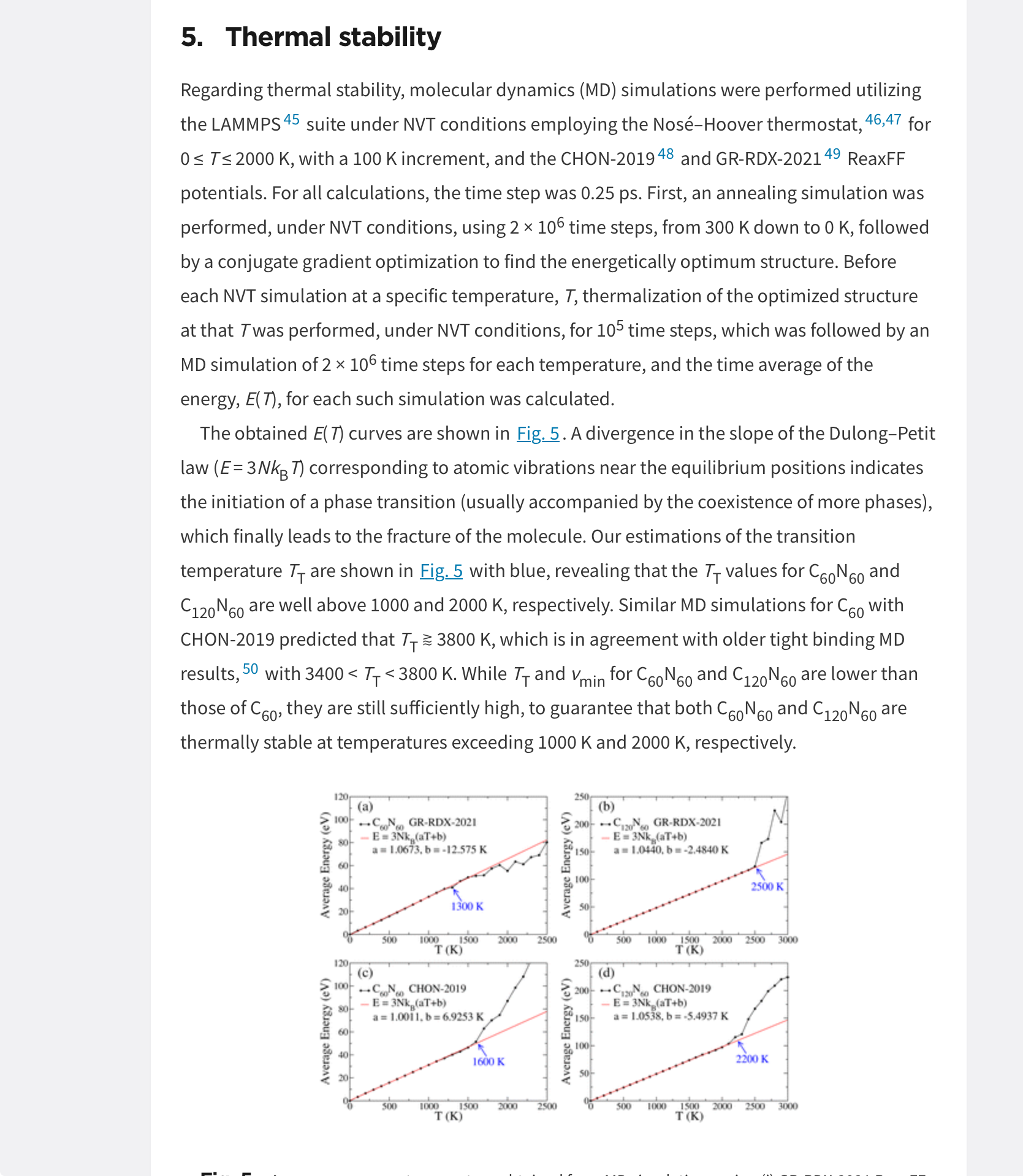
I have a paper revisions requested and they asked for stability calculations. I found a similar paper, they used MD calculations. Thier plot are shown below and they talk about atomic vibrations and Dulong-Petit law. I was wondering if that has anything to do with lattice dynamics of any sort I can calculate in CRYSTAL to measure this equilibrium point before phase transition occurs? So not necessarily the method in the paper below, but something similar that show molecular stability with a temperature in a similar fashion?
Thank you
-
Hello,
I get this error after optimising the geometry of one of solid solution structures:
[SYMMETRY ALLOWED INTERNAL DEGREE(S) OF FREEDOM: 6
TOTAL NUMBER OF PARTNERS = 2
NUMBER OF THE FIRST COMPONENT = 2
STAR VECTOR = 1
IRREDUCIBLE REPRESENTATION = 1
ERROR **** CLSEGV **** NOT PAIRING AT K = 7
----------------------------------------------------------------]The optimization starts as expected, but after reaching convergence criteria and going for FINALRUN calculations stops. Using obtained geometry for OPTGEOM restart or FREQCALC results in this error. All other 8 solid solutions were optimized smoothly.
-
Hello.
If I want to run a calculation with ATOMSPIN 1 for an ion that has no unpaired electrons in its valence orbitals (as defined in its basis set), should I define a new basis set for it ?
For example, I have a basis set for Oxygen 2- that is closed shell, and I'd like to force crystal to see it as O1- from the very beginning.
Should I write a new basis set for it or can I simply just use ATOMSPIN with the same basis set as for O2-?
Thanks a lot!
Chris
-
Hi!
I want to calculate the electric field gradient using POTC keyword (with CRYSTAL14) and am confused about the output. From the convention, the EFG components value should follow |CC|>|BB|>|AA|, which is not the case here. So my question is, can I consider the coordinate system to have an issue and just sort the output values to fulfill the convention and "rotate" the coordinate axes "by hand", or how should I interpret the output?Thank you for your help!
TOTAL ELECTROSTATIC POTENTIAL
3 POINT COORDINATES V0 V1(Z) V1(X) V1(Y)1 1.9790 2.3308 1.8870 -2.43511E+01 -1.44599E-04 -3.08862E-02 -2.33966E-02
2 -7.8558 -3.2175 1.8921 -2.75956E+01 3.35688E-05 -1.79861E-03 -5.24897E-03
3 -2.4880 0.9348 1.8905 -5.97785E+01 3.49451E-05 1.44597E-02 -8.08926E-03TRACELESS ELECTRIC FIELD GRADIENT TENSOR
POINT 1 POSITION 1.9790 2.3308 1.8870
TENSOR IN ORIGINAL CARTESIAN AXES
XX -4.074007E-02 YY 1.062909E-02 ZZ 3.011098E-02 XY -3.411483E-02 XZ -7.494557E-05 YZ -2.045206E-04TENSOR IN PRINCIPAL AXES SYSTEM
AA -5.775846E-02 BB 2.763815E-02 CC 3.012031E-02PRINCIPAL AXES
X Y Z
A 8.948364E-01 4.463906E-01 1.802221E-03
B -4.456747E-01 8.931575E-01 6.036308E-02
C 2.533584E-02 -5.481828E-02 9.981749E-01ANGLES BETWEEN PRINCIPAL AXES AND ORIGINAL AXES (DEGREES)
X Y Z
A 26.512576 63.487657 89.896740
B 116.466512 26.727256 86.539347
C 88.548208 93.142432 3.462197
-
Hello, I'm trying to calculate the bulk modulus of elasticity for a solid. I'm entering the following part of text in a *d.12 file:
...
EOS
RANGE
0.99 1.01 3
PRANGE
0 10 5
END
....
DFT
PBE
END
TOLINTEG
7 7 7 7 14
TOLDEE
9
MAXCYCLE
200
SHRINK
6 6
FMIXING
70
PPANThe calculation results return an error:
" ERROR **** SCF **** SG_IRR ALLOCATION ERROR: ALREADY ALLOCATED"Could you tell me what's wrong and what to do?
Thank you.
-
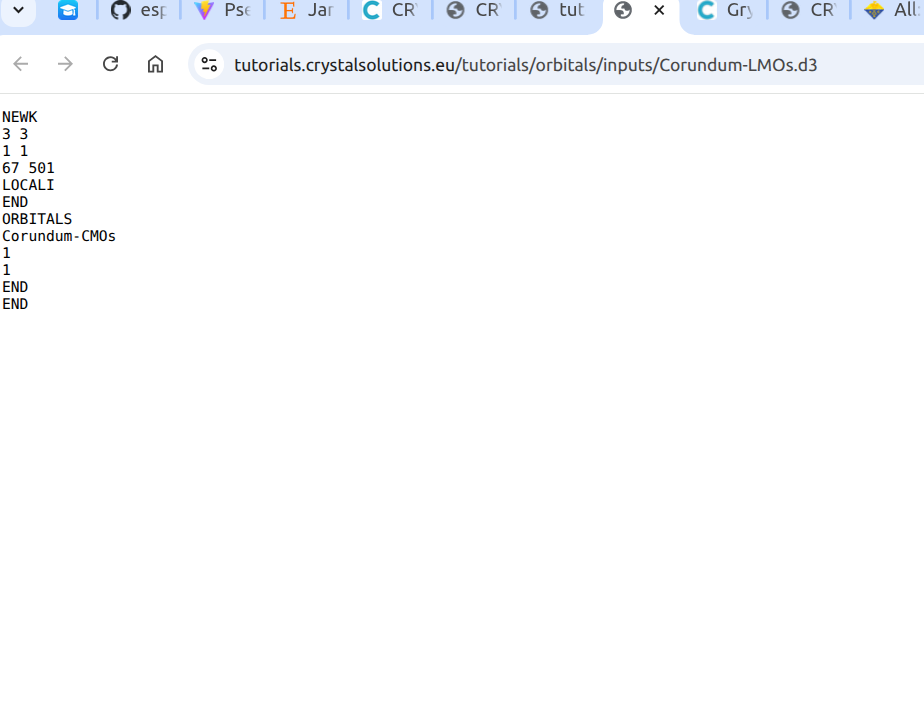
Hello, i I tried to calculate the molecular orbitals: "Crystalline Orbitals (COs) - Canonical Orbitals". I have the fort.9 file ready with the following .d3 file :
NEWK
8 8
1 0
ORBITALS
Pd_Cu_Act
1
0
END
END
After some time, in outfile an error appears:
ERROR **** F90MAIN3 **** KEYWORD ORBITALS NOT ALLOWED
Could you help which problem is this?
-
I want to build the carbon nanotube supercell with keyword “supercell ”, unfortunately, the crystal reports errors:“**** MULTIP **** SYMMOPS DO NOT FORM A GROUP ”
the INPUT file:
TEST07_1 - armchair C NANOTUBE - 6-21G, PBEsol
SLAB
77
2.47
1
6 -0.33333333333 0.33333333333 0.
SWCNT
5 5
supercell
2
end
-

The Department of Chemistry and the Thomas Young Centre at Imperial College London
 and the Theoretical Chemistry Group of the University of Torino
 , in collaboration with the Computational Materials Science Group of the Science and Technology Facilities Council (STFC), are organising the

MSSC2026 Summer School on
Ab initio Modelling in Solid State Chemistry
The School is designed for Master and Ph.D. students, as well as for post-docs and researchers who have an interest in getting or strengthening a background in:
 ️ Computational Solid State Chemistry
- 🧠 Physics
- 🧱 Materials Science
 Surface- and Nano-Science
 The week-long School consists of morning lectures and afternoon hands-on tutorial sessions, where the formal framework and functionalities of the CRYSTAL electronic structure package will be explored.
 While we strongly encourage in-person participation, we also offer the possibility to attend remotely through streaming of morning lectures and afternoon hands-on tutorials.
 Participants will have the opportunity to present their research at a poster session.
 You can register here!
Friday 8 May - Deadline for payment of early bird fees.See the School website for further details.
 aerba

 fbodo